Multi-Site SOC Field Guide
Architecture and staffing that scales.
Read article →Mean time to detect. Mean time to respond. The operational mechanics that turn alerts into actual incident reduction — not just more notifications.

Security operations live or die on the gap between event onset and effective response. Every minute that gap remains open is a minute the incident can escalate, the damage can compound, the offender can disappear. Closing the gap is the single highest-leverage operational improvement available — and real-time alerting is the mechanism that closes it.
But "real-time alerts" gets used carelessly. Plenty of systems generate alerts that arrive too late to enable response, or are buried under so much noise that they get ignored, or aren't routed to anyone who can act. This article walks through what real-time alerting actually means as an operational discipline, and how it concretely reduces incidents.
Every security incident has a lifecycle. Understanding it is the first step to compressing it.
T0 — Event onset. The thing happens. A perimeter breach, a theft, a fall, a fight, an after-hours intrusion.
T1 — Detection. Someone or something becomes aware the event has happened. In a traditional setup, this can be seconds (if an operator is watching), minutes (if a camera covers the area and the operator notices later), or hours (if discovery happens during footage review). The gap T1−T0 is mean time to detect (MTTD).
T2 — Response initiated. Action begins — security is dispatched, the offender is intercepted, the area is secured. The gap T2−T1 is mean time to respond (MTTR).
T3 — Resolution. The incident is contained, the offender removed, the area returned to normal state.
The total cost of an incident scales with T3−T0. Compress T1−T0 (faster detection) or T2−T1 (faster response) and total cost drops. This is the operational reason real-time alerting matters: every second saved on MTTD and MTTR is value protected.
In a traditional CCTV operation, MTTD is wildly variable. Best case: an operator happens to be looking at the right screen, detection happens in seconds. Median case: nobody is looking, detection happens during the next monitor sweep — minutes later. Worst case: nobody notices until a tenant complains, a stock count reveals theft, or a footage review surfaces it — hours, days, or never.
Real-time AI alerting collapses this distribution. Every feed is watched continuously by computer-vision models running at the edge or in the cloud. Detection latency is bounded — typically 2–10 seconds from event onset for clear events, 10–30 seconds for more complex behaviour patterns that require multi-frame confirmation.
The shift isn't best-case improvement; it's variance collapse. Detection goes from "between 5 seconds and never" to "reliably under 30 seconds". For security operations, predictable speed is more valuable than peak speed.
The components that make this work:
Fast detection without fast response is wasted detection. The response side is harder than the detection side because it involves humans, but the structural improvements are well-understood.
What compresses MTTR:
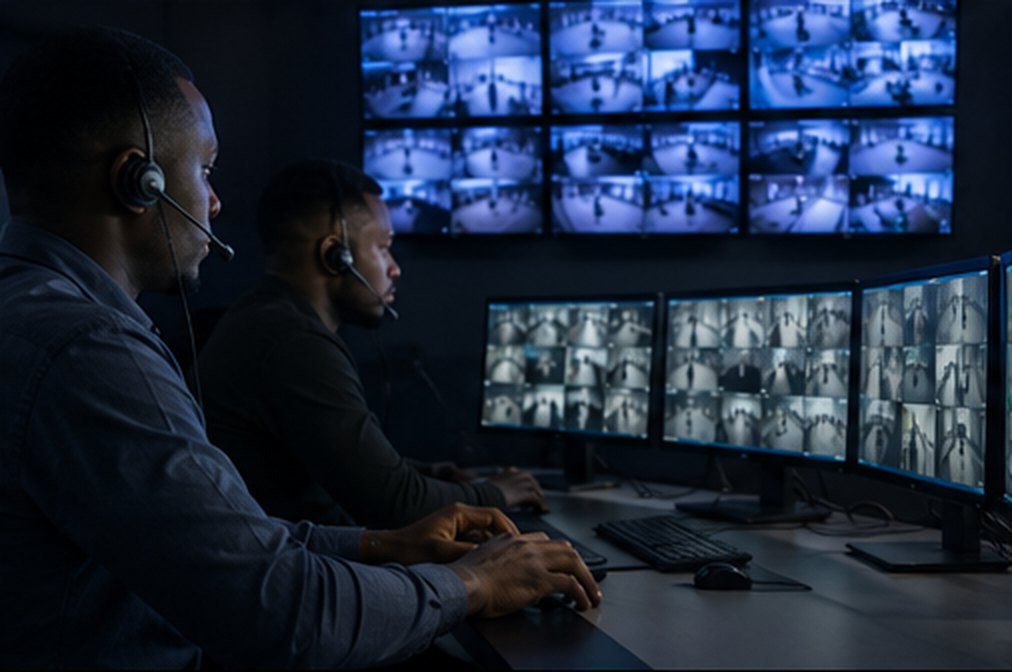
Routing the alert to someone who can act. A control-room dashboard isn't enough if the operator is monitoring 60 feeds. The alert needs to reach the specific person — by name, by role, by shift — who is on duty for that site, that zone, that time of day. AI alerting platforms support per-alert routing rules; legacy systems usually don't.
Including everything needed for response in the alert. Camera ID, location, event type, confidence, recent context, the live feed, the action options. An operator who has to look up the camera location in a paper map loses minutes.
Pre-defined response playbooks. "Perimeter breach at the south gate, after hours" should have a predefined response — escalate to mobile guard, contact site manager, dispatch external response if no acknowledgement in N minutes. The operator follows the playbook; they don't improvise under pressure.
Multi-channel delivery. The alert reaches the responder via whichever channel they're actually on — control-room dashboard, mobile app, SMS, voice call escalation. Single-channel alerts get missed when the operator is briefly away from the console.
Tracking acknowledgement. If the alert isn't acknowledged within a defined time, it auto-escalates. Nothing falls through because nobody happened to be looking.
Sorveo's alert-response reporting lets you compare your current MTTD with post-deployment MTTD, side by side.
You can't talk about real-time alerts without talking about alarm fatigue. Every operations leader has seen it: an alert source becomes high-volume and low-signal, operators learn to ignore it, real alerts eventually go unactioned.
Alarm fatigue is the silent killer of alerting systems. Once an alert source is structurally ignored, the operation is back to where it was before the system existed — except now everyone thinks they have alerting.
What prevents alarm fatigue:
A well-tuned alerting platform delivers 15–25 events per operator per shift — each one meaningful. A poorly-tuned platform delivers hundreds of events per shift, 90% noise. See the broader best-practices framing.
The under-discussed dimension of real-time alerts is deterrence. Offenders adjust behaviour based on what they perceive the security operation can detect and respond to.
In a traditional CCTV operation, offenders quickly learn the operational rhythm — when staff are watching, when they're not, which cameras have known dead zones, where to operate. Most habitual offenders are working from real (if informal) knowledge of the operation.
Real-time alerting changes the deterrence calculation. When detection happens reliably in seconds and response happens in minutes, the offender's calculation shifts: the expected cost of the attempt rises. Across mall deployments specifically, we see meaningful reductions in repeat offending from the same individuals within 60 days of AI deployment — they stop targeting the site.
This is a real and durable effect, but it requires the alerting actually being acted on. Deterrence collapses if alerts are routinely ignored. Which is why solving alarm fatigue isn't just an operator-quality issue — it's a deterrence issue.
Real-time alerting effectiveness is measured by outcome, not by alert volume. The metrics that matter:
If your alerting platform doesn't surface these metrics natively, your operations team should be building them — they're how you know the system is delivering value.
A short, opinionated playbook for designing a real-time alerting pipeline that actually reduces incidents:
An alert is any notification that something happened. A real-time alert reaches the responder fast enough to enable intervention — typically within seconds of the event onset.
Alarm fatigue. When false positive rates cross an operator's tolerance threshold, they begin to ignore alerts in batches, eventually missing real ones too.
Three mechanisms: compression of MTTD enabling intervention before damage; deterrence as offenders learn the operation is actively monitored; and operational signal that drives systemic improvements over time.
Sorveo's real-time alerts are built around the operational mechanics above — confidence-gated, intelligently escalated, outcome-measured. Book a discovery call to talk through how alerting would work on your sites.
A discovery call about how your team responds today. We'll tell you where Sorveo would speed things up.