How AI Is Transforming CCTV Monitoring in Africa
A practical look at how AI is reshaping CCTV across Africa.
Read article →Shrinkage. Slip-and-fall. Crowds. Lost children. After-hours intrusion. Inside the real AI use cases that move the security needle in modern shopping malls — drawn from production deployments.
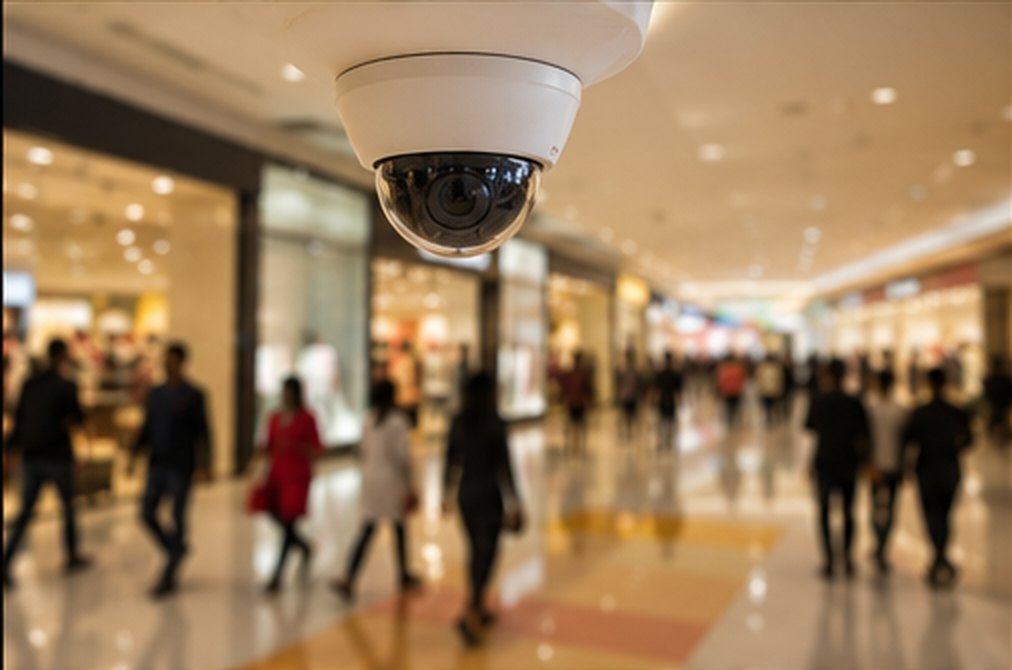
Modern shopping malls are some of the most camera-rich environments in the built world. A typical 80,000 m² mall in Lagos, Nairobi or Johannesburg runs anywhere from 200 to 600 cameras — covering entrances, food courts, tenant fronts, anchor stores, parking, loading bays, service corridors and back-of-house.
But camera density doesn't translate to security effectiveness. Two operators in a control room cannot meaningfully watch 400 feeds. The recording happens, the storage spins, the bills get paid — and the security team still discovers most incidents after the fact, from a tenant complaint or an insurance claim.
The story of AI in mall security is the story of closing that gap. This article walks through the specific use cases where AI delivers measurable wins, drawn from production mall deployments across Africa and beyond. The pattern is consistent: malls don't rip out their cameras; they add an AI intelligence layer on top and watch the gap close.
Shrinkage — the gap between what stock the books say a tenant has and what's actually on the shelves — is the single largest line item where AI changes the calculus.
In the legacy model, theft is discovered in two ways: a tenant catches someone in the act (rare), or stock count reveals the gap weeks later (common). Neither leads to good outcomes. Live catches are usually random; stock-count discoveries identify that theft happened but not by whom, leaving the only response a generalised tightening of security that punishes paying customers.
AI changes this in three concrete ways:
The outcome we see most often: a 20–40% reduction in reported shrinkage over a 90-day window from baseline, with the wider effect of changing offender behaviour — the same individuals stop targeting the mall once they understand it's actively monitored.
Mall security isn't only about deterring incidents; it's also about preventing crowd events from turning into incidents in the first place. Peak weekends, holiday seasons, anchor-tenant promotions — each creates crowd densities that the static design of the mall (entrances, escalators, food court flow) wasn't built for.
AI video intelligence runs real-time occupancy and crowd-density analytics across every monitored zone. Operations sees, on a single dashboard:
The operational difference is that staff dispatch becomes predictive. When food-court occupancy approaches a threshold, additional cleaners and floor staff get dispatched before the bottleneck forms. When parking flow drops below normal, operations investigates whether an entrance is blocked. When a queue at the main entrance exceeds 15 people, additional security is sent to manage it.
Slip-and-fall claims are an underappreciated cost line for mall operators. A single legitimate claim can run into mid-six-figures in some markets; a fraudulent claim still creates legal cost even if defeated.
The legacy CCTV response to a claim is to manually scrub hours of footage, hoping the relevant camera captured the moment and the surrounding context. With 30 days of footage on 400 cameras, this is a multi-hour task that frequently fails to find the relevant clip at all.
AI video intelligence indexes every event as it happens. When a slip-and-fall is reported, the mall can:
The same workflow defeats most fraudulent claims, where the alleged event simply doesn't appear in the footage at the claimed time.
A discovery call about your mall and its incident profile. We'll tell you whether Sorveo is a fit, and exactly how it would help.
Two use cases at opposite ends of the emotional spectrum, but operationally similar.
Lost children. A parent reports a missing child. Legacy response: announcement on the PA, visual search by available staff across the mall. AI response: descriptor-based search (last-seen clothing, approximate age) across all 400 cameras over the previous 30 minutes, narrowing the search radius to the cameras that have seen the matching subject. Time-to-locate drops from 20–40 minutes (sometimes worse) to under 5.
Persons of interest. Mall security maintains a watchlist of individuals — banned shoplifters, threat actors, persons subject to court orders. Modern AI runs face matching against the watchlist in real time, with confidence thresholds tuned by the operator. When a match exceeds the threshold, security gets a live alert with the camera and last-seen location.
Both use cases require careful policy framing. Watchlist content is the mall's own; matches happen only against that watchlist (not against an unbounded face database); and retention/access governance is documented and audited. More on the responsible deployment of facial recognition.
The mall after closing is a different security problem. Service corridors, loading bays, and tenant back-of-house are vulnerable in ways the customer-facing floor isn't. The cameras are there; the operators usually aren't watching them.
AI video intelligence runs perimeter rules and motion-detection logic out-of-hours, with different sensitivities and exclusion zones from the daytime ruleset. Any detection in a restricted zone after hours generates a live alert to the duty manager or external monitoring service.
Configurable elements include:
An often-overlooked dimension of AI security in malls is that the analytics aren't just for the mall operator. They become a value proposition for tenants — particularly anchor tenants and larger chain stores.
Specific tenant-facing services malls increasingly offer on top of AI:
For mall operators, this is a tenant-stickiness story: the analytics offering deepens the value of being a tenant in the mall, which materially affects lease negotiation and renewal.
A mall with 400 cameras has, at any given moment, a meaningful number of cameras that are dark, obstructed, or misaligned. Across the deployments we assess, 8–15% is typical; we've seen above 20% in poorly-maintained estates. Every dark camera is a guaranteed blind spot.
AI video intelligence platforms treat the camera estate as critical infrastructure and monitor it continuously. Signal loss, obstruction, sudden tilt, contrast failure, frame rate drop — each becomes a maintenance ticket the moment it's detected. Blind spots that previously persisted for weeks get fixed within a day.
The compounding effect: as the camera estate gets healthier, the AI detections get more reliable, which raises operator trust in the alert system, which means alerts get acted on faster. The flywheel reinforces. More on why dark cameras are the most overlooked CCTV problem.
The deployment pattern that works in mall settings is straightforward:
Most malls go from kick-off to estate-wide live monitoring in 6–10 weeks. The largest African mall deployment we've supported went from contract to estate-wide in 11 weeks.
Shrinkage reduction is usually the largest single line item. AI behaviour analytics flag suspicious dwell, concealment patterns, and watchlist matches in real time, so loss prevention teams intervene during the act rather than during a quarterly stock-count discovery.
Yes. AI video intelligence timestamps and indexes events as they happen, so when a slip-and-fall is reported, the mall can retrieve the exact clip in seconds — including the moments before and after — for the insurance and legal process. This both supports legitimate claims and exposes fraudulent ones.
Yes. Modern AI platforms layer on top of existing IP, NVR, and hybrid camera estates. Most malls keep every camera they have; the intelligence is added in software. Mixed-vendor estates are the norm and are explicitly supported.
Sorveo deploys AI video intelligence across malls in Nigeria, Kenya, South Africa and beyond. Book a discovery call to talk through your sites, or explore the dedicated malls solution page.
A practical look at how AI is reshaping CCTV across Africa.
Read article →
Where facial recognition earns its keep, where it fails.
Read article →
Seven diagnostics you can run this week.
Read article →A discovery call about your mall. We'll show you exactly where AI would change the picture.